Calibrating Performance...
— Protocol Exchange
Community Forum
Share knowledge, refine training protocols, and connect with elite athletes in our high-performance discussion hub.
 announcement
Marcus Steeletrainer
FitPulse Community Challenge: 30-Day Consistency Streak
Starting next Monday, we are launching our biggest community challenge yet: the FitPulse 30-Day Consistency Streak. The mission is simple — train at least once every day for 30 consecutive days. But this is not about grinding yourself into the ground. The challenge is designed to build the habit of showing up, not the habit of overtraining. You decide what counts as training each day. It could be a scheduled class at FitPulse, a home workout following one of our program templates, a run or cycle outdoors, a yoga session, or even active recovery like a 30-minute walk combined with mobility work. The only rule is that you must do something intentional for at least 20 minutes every day and log it in the FitPulse app under the Challenges tab. We have built a tracking system that will show your streak, your fellow participants, and a community leaderboard organized by streaks and total activity minutes. There are milestone rewards at 7 days (FitPulse digital badge), 14 days (15% off your next class pack), 21 days (free guest pass for a friend), and the full 30 days (exclusive FitPulse 30-Day Champion t-shirt plus entry into a drawing for three months of unlimited classes). We will also have weekly check-in threads in this forum where you can share your experiences, struggles, and tips. Our coaches will post daily motivation and mini-challenges to keep things interesting. To make this sustainable, I strongly recommend incorporating at least 2-3 active recovery days per week — mobility sessions, light swimming, or even a dedicated stretching practice. The goal is to build the identity of someone who moves every day, not to accumulate fatigue. Registration opens now in the app. There is no cost to participate, and all current members are automatically eligible. Let us see what this community can do when we commit to showing up together. Who is in?
 nutrition
Sarah Mitchelltrainer
Meal Prep Mastery: A Week of High-Protein, Nutrient-Dense Meals
Meal prepping is the single most effective strategy for maintaining consistent nutrition throughout a busy week. When your refrigerator is stocked with ready-to-eat, portion-controlled meals, the likelihood of reaching for convenient but nutritionally poor options drops dramatically. In this guide, I walk through my weekly meal prep system that takes about 2-3 hours on Sunday and sets me up for success Monday through Friday. Start with a protein base: grill 2-3 pounds of chicken breast seasoned with garlic, paprika, and herbs; prepare a batch of lean ground turkey or beef with taco seasoning; and hard-boil a dozen eggs for quick snacks. For carbohydrates, choose complex sources that provide sustained energy: cook a large batch of quinoa or brown rice, roast sweet potatoes and regular potatoes with olive oil and rosemary, and prep steel-cut oats that can be reheated with protein powder and berries in the morning. Vegetables should fill half your plate: roast a sheet pan of broccoli, bell peppers, zucchini, and cherry tomatoes drizzled with balsamic vinegar; prepare a large salad base of mixed greens with cucumber, cherry tomatoes, and a homemade vinaigrette (olive oil, apple cider vinegar, Dijon mustard, and herbs); and steam or sauté spinach and kale for quick sides. Healthy fats come from avocado (store with the pit to prevent browning), almonds and walnuts (portion into small bags), chia seeds and flaxseed for smoothies, and olive oil used in cooking and dressings. Sample day structure: breakfast is overnight oats with protein powder, berries, and almond butter; lunch is grilled chicken breast with quinoa, roasted vegetables, and avocado slices; afternoon snack is Greek yogurt with berries and a hard-boiled egg; dinner is turkey chili with sweet potato and a side salad; evening snack is cottage cheese with flaxseed and cinnamon. Portion everything into glass containers labeled by day. This system has helped dozens of my clients maintain consistent nutrition while reducing decision fatigue and saving significant time during the week.
 training
Alex Riveratrainer
Deload Weeks: How and When to Pull Back for Long-Term Gains
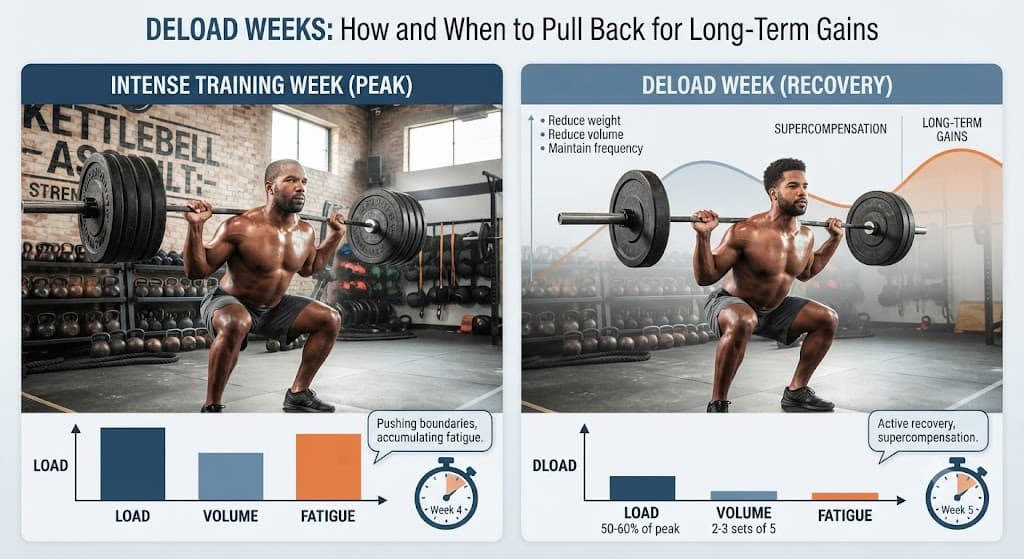
Every few weeks, I get asked the same question from athletes: "Do I really need to take a deload week?" My answer is always the same: yes, if you want to keep making progress. A deload is a planned period of reduced training volume and intensity that allows your body and nervous system to fully recover from accumulated training stress. Think of it as a strategic reset rather than a step backward. The general guideline is to deload every 4-6 weeks of consistent training, but this varies based on training intensity, volume, individual recovery capacity, age, sleep quality, and overall life stress. Signs that you are overdue for a deload include plateauing or decreasing performance, persistent muscle soreness that does not resolve with normal recovery, elevated resting heart rate, poor sleep quality, increased irritability or mood swings, loss of training motivation, and increased frequency of minor injuries or illnesses. How to structure a deload: reduce training volume by 40-60% while keeping intensity (weight on the bar) at 70-80% of your working weights. The key is to maintain movement patterns and neuromuscular coordination without accumulating significant fatigue. Drop sets per exercise from 4 to 2, reduce training frequency if needed, and eliminate accessory work to focus on main lifts only. Alternatively, you can take a full week off from structured training and engage in enjoyable physical activities like hiking, swimming, recreational sports, or yoga. Many athletes return from deload weeks setting new personal records because they allowed their systems to supercompensate. Do not view deloads as lost time; view them as investments in your future progress. The athletes who train hardest are often the ones who need deloads most. Be smart, be patient, and trust the process.
 recovery
Elena Vasqueztrainer
Breathwork for Athletes: Techniques to Improve Performance and Manage Stress
Breathing is the most fundamental physiological process we have, yet most athletes never train it intentionally. Proper breathwork can improve athletic performance, accelerate recovery, and manage competition anxiety more effectively than many supplements. This post covers three breathwork techniques with specific applications for athletes. First, diaphragmatic breathing (belly breathing) is the foundation. Most adults are shallow chest breathers due to chronic stress and poor postural habits. To retrain the diaphragm, lie on your back with one hand on your chest and one on your belly. Inhale slowly through your nose for 4 seconds, feeling your belly rise while your chest remains relatively still. Exhale through your mouth for 6 seconds, feeling your belly fall. Practice for 5 minutes daily, gradually extending the exhale to 8 seconds. This activates the vagus nerve and shifts your autonomic nervous system toward parasympathetic dominance. Second, the Wim Hof breathing method involves cycles of 30-40 deep rapid breaths followed by breath retention. This technique increases blood oxygenation, alkalizes blood pH, and has been shown to reduce inflammation and improve immune function. Use this before training sessions requiring high anaerobic output or as part of your morning routine. Third, box breathing (4-4-4-4 pattern) is the gold standard for performance anxiety management. Inhale for 4 seconds, hold for 4 seconds, exhale for 4 seconds, hold empty for 4 seconds. Repeat for 3-5 minutes before competitions, heavy lifts, or any high-pressure situation. This technique stabilizes heart rate variability and improves cognitive clarity under stress. For recovery, try 4-7-8 breathing: inhale for 4 seconds, hold for 7 seconds, exhale for 8 seconds. Practice this immediately after training or before sleep to accelerate parasympathetic recovery and improve sleep quality. Consistent breathwork practice of 5-10 minutes daily yields measurable improvements in resting heart rate, heart rate variability, and perceived recovery within two weeks.
 announcement
Sarah Mitchelltrainer
Announcement: New Outdoor Training Pavilion Coming to FitPulse
We are thrilled to announce that construction of our new Outdoor Training Pavilion will be completed by the end of next month. This 3,500-square-foot covered training space will allow us to expand our class offerings and provide a unique outdoor training experience protected from the elements. The pavilion features a reinforced concrete foundation suitable for all types of training including Olympic lifting, strongman implements, and high-intensity interval circuits. It is equipped with heavy-duty rigging for gymnastics rings, battle rope anchors, and suspension trainers, as well as dedicated platform space for barbell work. The perimeter is lined with artificial turf for sled work, agility drills, and bodyweight conditioning. We have installed industrial-grade fans for air circulation and overhead LED lighting for evening sessions. The pavilion will host a new roster of classes including Outdoor HIIT, Turf Wars (a team-based functional fitness competition), and Saturday Morning Strongman sessions. Existing classes will also rotate outdoor sessions when weather permits. We are scheduling a grand opening event on the first Saturday of next month featuring free trial classes, equipment demonstrations, a nutrition booth with sample meals from our partner kitchen, and a community barbecue. All members are invited, and we encourage you to bring a friend who might be interested in joining the FitPulse community. Class schedules will be updated in the app and on our website within two weeks, and early registration for outdoor pavilion classes opens next Monday at 9AM. Spaces will be limited to maintain quality coaching ratios. We cannot wait to train with you under the open sky. Stay tuned for more updates and construction progress photos on our social media channels.
 recovery
Maya Chentrainer
The Science of Recovery: Why Rest Days Are Non-Negotiable
In the fitness world, we often celebrate the grind — the early morning sessions, the pushed-through fatigue, the extra rep when everything in you wants to stop. But what we do between workouts is just as important as what we do during them. Recovery is not a sign of weakness; it is a physiological necessity. When you train, you create micro-tears in muscle fibers and deplete your nervous system. Growth and adaptation happen during rest, when your body repairs those tears and builds back stronger. Without adequate recovery, you enter a state of diminishing returns where performance plateaus, injury risk skyrockets, and hormonal balance suffers. This post covers the key pillars of effective recovery: sleep (aim for 7-9 hours of quality sleep per night — this is when growth hormone secretion peaks and tissue repair occurs at its highest rate), active recovery (light activities like walking, swimming, or gentle yoga on rest days promote blood flow and nutrient delivery to recovering tissues without adding significant stress), nutrition (post-workout meals should include protein to support muscle protein synthesis and carbohydrates to replenish glycogen stores; timing within the 30-60 minute anabolic window is beneficial but not as critical as total daily intake), stress management (chronic elevated cortisol impairs recovery and can lead to overtraining syndrome; incorporate meditation, deep breathing, or other relaxation practices), and hydration (even mild dehydration impairs performance and slows recovery). Signs that you may need more recovery include persistent fatigue, decreased performance, mood disturbances, increased resting heart rate, and frequent illness. Learn to distinguish between the productive discomfort of training and the warning signals of overreaching. Your body is your most important training partner — treat it with respect.